
|
|
| September 3 - September 10 |
|
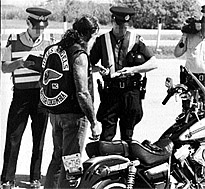
A newspaper once defined them the richest angels on Earth, but for many they are an organization that manages to make tradition and modernity live side by side, a mix where a ferocious sense of personal loyalty and the willingness to move capitals and people over long distances have been coexisting for decades. Law enforcement agencies all over the world have recently taken notice of them: "Hells Angels lack nothing in comparison to La Cosa Nostra or other organized criminal groups." Maybe they have something more; they are the fastest-growing criminal organization, with 111 "branch offices" spread over three continents: in the U.S., Canada, Austria, Belgium, Denmark, Finland, France, Germany, the United Kingdom, Liechtenstein, Norway, Spain, Sweden, Switzerland, the Netherlands, Australia, New Zealand, South Africa, Brazil and even Italy. Two former members of Denmarks Hells Angels thus defined those belonging to their organization: "Angels are unrepentant rebels, agents provocateurs by vocation and troublemakers for no specific reason." Their culture is founded on violence, that increases profits in business and is the foundation and guarantee of criminal power in everyday life. In Bikerdome, violence is the seed capital of the outlaw biker: the fundamental element for conquering power and richness and defending them. Without violence there would be no biker gangster: he would be a walking corpse. Hells Angels, like the other biker gangs, do not hide their affiliation; on the contrary they exhibit it. From this point of view they are very similar to the Japanese gangsters who cover their bodies with tattoos, declaring their belonging to the Yakuza. These are uniformed criminals, even if today, as Canadian crime writer Yves Lavigne wrote, they tend to wear tuxedos more than the leather jackets with the winged skull. In spite of the changes, they remain unique. "They are an atypical criminal organization," explains RCMP Staff Sergeant Jean-Pierre Levesque, an international expert on motorcycle gangs. There are two operational levels: one involving the organization as a whole and the other exalting the bikers individualist spirit. Ranks close when the interest of the gang must be defended, but they split when running the various illicit activities. "Contrary to other criminal organizations, the Hells Angels and the other similar groups operate on an individual basis," adds Levesque. "Belonging to the Hells Angels guarantees to each member the possibility of running an illicit activity." Club colours are a sort of passport to enter the underworld and deal with other bosses. This is the main characteristic of the biker gangs, that sociology could label as "amoral individualism" in contrast to the "amoral familism" characterizing other criminal organizations such as the ndrangheta, the Mafia, and La Cosa Nostra. They also have codes, although initiation rituals are no longer those of the beginning of the organization. "When in 1982 I was admitted into this organization, there was no ceremony," told us Anthony Tait, a U.S. citizen, and a former member of the Hells Angels in Alaska currently in the Witness Protection Program. "They invited me to a bar they patronized where they threw a party in my honour. There were women and a lot of beer." Hierarchies do exist, albeit their valour is more form than substance. "The richest or smartest element is not always the chairman of a chapter," adds Levesque. Like the Mafia, the Hells Angels are a monosexual organization. Women are not formally admitted, nor do they swear allegiance. They follow their men, or join the gangs to satisfy the sexual appetites of the bikers, who compensate them with drug and protect them from nighttime threats. Hells Angels are well connected with the world of prostitution and of nightclubs. It is they, along with other groups, who control the lap dancers in the clubs and the prostitutes on the streets. "But dont call them pimps, they get angry," warns Lucy, a prostitute who once worked for them. "When I asked for their protection they requested a test of my qualities. That night five of them took me. They were drunk." Since then, she had no problem finding jobs in the nightclubs. "I gave my protectors a quota of my income every week." Michael Welzembach, for the Readers Digest, interviewed many women who had had something to do with the Angels. "One of them," tells Welzembach, a former columnist for the Washington Post, "was raped and tortured for her boyfriends debts. Horrible stories." On August 9, 1995, Daniel Desrochers, an 11-year-old boy, was sitting on his bicycle a short distance from the "Saint Nom de Jesus" Junior School, in Montreal, when he was hit by the blast of a bomb planted under a jeep owned by Marc Dube, a drug dealer connected to the Hells Angels. The boy died of his wounds the following day, an innocent victim of the war raging between the Hells Angels and rival gang Rocky Machine, that since 1994 in Quebec has claimed more than 100 lives. "They vie for control of the land, the drug market," explains Levesque who also anticipates the next moves of the Angels: "They will try to gain a foothold in Ontario, theyve been trying for some time." In the last three years, the Hells Angels relieved the Rebels in Saskatchewan, the Grim Reapers in Alberta and the Los Bravos in Manitoba. What will happen if, as the Criminal Intelligence Service of Canada foresees Angels should try to penetrate in Ontario? "The Outlaws, traditional enemies of the Hells Angels, will try to oppose them in any way possible," Levesque suggests. "And the other main gangs, such as Satans Choice, the ParaDice Riders and the Vagabonds, who recently learnt how to get along, could do the same." However, Levesque does not think this likely: "The Vagabonds and the ParaDice always were in good relations with the Hells Angels. I wouldnt be surprised if some member of the ParaDice decided to go with the Hells Angels, helping them to establish their first chapter in Ontario." The Hells Angels are ready. They arent afraid of exposing themselves. When they have to threaten somebody, they have no problem. In March 1998 some police officers and some judges gave up for fear of revenge. "Some police officers refused to investigate on cases that involved the Hells Angels," tells Detective Al Dalstrom of the Vancouver Police. "And I know that some public prosecutors assumed the same stance, because of their concern for their own safety and that of their families." Bob Pryor, the attorney who coordinates the public prosecutors in British Columbia, confirms: "We suffered some defections for fear of reprisals." Even journalists have been targeted. Minister of Justice Ann McLelland was forced to admit that the current strength and impudence of the Hells Angels are due to decades of underestimation. "We allowed them to grow undisturbed. And now in Canada they are the number one public enemy." (translated by Emanuele Oriano) |
||||||||||||||||||||||||||
| * The Angels purposefully omit the apostrophe in their name as a trademark feature. |
|
Part: 1 / 2 / 3 / 4 / 5 / 6 / 7 / 8 / 9 / 10 / 11 / 12 / 13 / 14 / 15 / 16 / 17 / 18 / 19 / 20 / 21 / 22 |
 |