
|
|
|
| June 17 -June 24 |
|
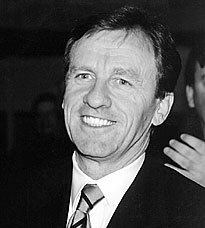
Health Minister Allan Rocks frantic activity stands out from the very moment one enters his Ottawa office, despite having recently undergone surgery to treat prostrate cancer. While a meeting is approaching conclusion in one room, another one is being prepared next door. Following our interview, a television crew is ready to jump in. Minister Rock, your illness seems to have left no mark on you. "I was very lucky. It was detected very early, and surgery usually has complete efficacy in those cases." Did your fight against cancer change you? "You cant go through an experience like that when you are told you have cancer, you undergo major surgery, and you have six-seven weeks recuperation time without looking at your life in a critical way and asking yourself whether you are doing what you really want, making every day of your life count." In those weeks, did you consider abandoning politics? "I wouldnt say that I would quit politics, but I looked critically at what I was doing and I said to myself that I could go and practice law, or do another business, or whatever I wanted to." What did you conclude? "The conclusion was that I am doing exactly what I want to do. The privilege of being part of the national government, being in the Parliament, helping to determine the future for my children. Thats important." You must have thought about your past as well. What did you remember? "Many things. In particular I remembered when I was in high school and I was having some difficulties in deciding what I wanted to do, and a teacher that I liked very, very much, said make your passion your profession. My passion is Canada, my country, making it a better place for our children. And thats how I want to spend my life." What if Jean Chrétien won a lottery and retired. Would you be interested in taking his place? "Everything has to do with timing. With the opposition as it is, with his support in the party and in the country, I wouldnt rule out that the Prime Minister would run for a fourth term." What if he wins that lottery? "Then I would definitely be interested in the leadership and I believe that we would have many good candidates. We have a lot of talent in government, caucus, and in the party." Lets talk about Canada. Everything looks good. What problems do you see on the horizon? "We have overcome a lot in recent years, like deficit, paying down the debt and so on, but there are so many other challenges we still face. Canada has to find its place in a very rapidly changing world." You are talking about globalization. "Sure. What it really means is that the traditional barriers between nations are coming down. Every nation that wishes to have prosperity and create opportunity for its people has to understand that an educated workforce is necessary, and shrewd choices in making priorities are needed. One of the major challenges we are going to face is continuing prosperity in a rapidly changing world. Being able to compete with educated people across the planet. Its going to be a major challenge in the coming years." We mention the world, but 87 percent of our trade is with the United States. Is this closeness a blessing or a curse? "We should never be intimidated by the United States. We have the confidence and the capacity to be our own separate nation. We are unique, we have strength and we do not have to fear them. In fact, we are fortunate to have that neighbour, they are our major customers. At the same time we have to continue to strengthen those things that are unique to Canadians and to remain a robust nation, separate and to ourselves. That means strengthening cultural industries, coming to a definition of what we are as a people and understanding how that can be built upon. Also, we have to diversify ourselves." How? "We have to remember that Europe is our historical partner. There is a lot to do. This does not mean we have to harm our relationship with the United States, but simply increase ties with other partners, and Europe is as large a market as the United States." Back to the government. Dont you think that winning four elections in a row is a bit difficult? "There were also people who were saying that Mr. Chrétien wouldnt make the third time. In each case Canadian people have to look at the alternatives, have to decide who they have confidence in, and also they have to decide who has the best ideas for the future. And I believe that the Liberal government can do that again." Yes, but there is an alternative. The Bloc destroyed opposition in Quebec, and the Reform Party did likewise in the rest of Canada. Is there a danger of becoming arrogant? "We have to be very careful that it will not happen. Speaking of the Bloc Québecois, I think they lost, if they ever had, their raison detre; its gone. Its more and more complicated to explain why they are still in Ottawa, what function they serve. During the last election in Quebec we did extremely well and I think that next time we are going to do even better. The population in Quebec is finding more and more difficult to understand what function the Bloc Québecois serves, what positive role they have to play in the national debate and in the discussion of Canadian issues, and I think that we have enormous opportunities in Quebec in the next election." What is the Federal Minister of Health, now that the Romanow committee is at work? "Many things. Last September we had an agreement almost without precedent amongst all governments. Since the adoption of medicare, this is the most significant agreement among governments in the sector. Its not just a transfer of additional money to the provinces. We have a seven-page agreement that identifies a list of priorities. Since that time Im working with provincial ministers of health to implement that agreement." For instance? "A national strategy on nursing, increasing the number of doctors in the country, managing the cost of pharmaceutical drugs, new money for telemedicine and much more. Outside that system we have the new legislation for assisted human reproduction, we have a draft proposal in front of the committee on cloning, the organ donation campaign, we started the Canadian Institute for health research and much more. The agreement of last September hopes to stabilize the current health system for the short-medium term. Mr. Romanow has been asked to look at 10-15 years out, when there will be other problems to cope with." Are you referring to baby-boomers growing old? "Exactly. He has to figure how we hang on to the basic principle of medicare in a changing world, with an ageing population that will increase the costs down the road. And, as the baby-boomers approaches middle age and then old age, how are we going to afford the medicare costs. Thats what Mr. Romanow has to look at. In the meantime, a lot remains to be done." An assistant knocks on the door: the television crew is ready for their interview. Thank you, Mr. Rock. Who knows, maybe Chrétien will win the lottery after all. |
||||||||||||||||||||||||||

|
|
Up-front / Mainstreet / Focus / Opinion / Italy / Movies / Music / Theatre / Culture / Fashion / Travel / Food / Computers / Sports |
 |