|
|
 |
| |
| Promoting Italian-Canadian cinema |
| |
 by Daniela Sanzone by Daniela Sanzone
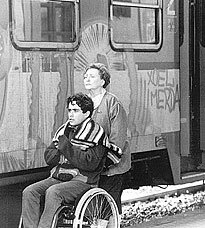
Can we talk of an Italian-Canadian cinema? Having reached its third edition, the Toronto Italian Film Festival, supervised by Carlo Coen, director of the Istituto Italiano di Cultura, is pondering this question. In Coens words, "sure we can, it is mainly done in Quebec and most often has Tony Nardi as a protagonist, but also other authors, actors, and filmmakers, such as Carlo Licont, Nick Marciano, Gerry Mendecino, Tony Napo, and Silvio Oliviera".
From June 15 to 19, the Bloor, Royal, and Cumberland movie theatres will screen films whose common denominator is their belonging to a new cultural profile, such as Paul Tanas trilogy on the experience of Italian immigrants to Canada, La Deroute, La Sarrasine, and Caffè Italia Montréal; and James Allodis The Uncles.
In addition to these, there will be screenings of 15 short films made in Canada, running from three to 36 minutes each, and 15 Italian films chosen among those launched in 1999 and 2000, mostly independent productions.
In particular, a work by Cristiano Bortone, Sono positivo ("Im positive"), attempts an ironic and adventurous approach to the problem of coping with AIDS; and Sud Side Stori, an anti-racist movie with a curious role reversal between the protagonists, Romea and Julietto. The film is directed by Roberta Torre, who moved from Milan to Sicily because she was struck by Palermos vital and cultural richness.
Also screening will be Prime luci dellalba ("The Dawns Early Lights") by Lucio Gaudino, Le mani forti ("Strong Hands", 1997) by Franco Bernini, starring real-life couple Claudio Amendola and Francesca Neri; and Il prezzo ("The Price") by Rolando Stefanelli.
On June 15 at 7 p.m. Francesco Ranieri Martinottis Branchie, the epic of a character reluctantly ready for anything, will open the Festival. The film stars singer Gianluca Grignani in the main role, and derives from a novel by young author Niccolò Ammanniti, who gained fame some years ago with other novelists such as Isabella Santacroce with a genre nicknamed "cannibal literature." It is characterized by strong themes, aggressive style, breaking rules, now a part of Italian mainstream but very innovative during the final decade of the last century. u

|
| Washroom Warfare |
| |
By Donna Lypchuk
Visiting the Little Girls Room can be a dangerous mission a matter of life or death. The Gulf War has nothing on the kind of germ warfare we battle in public washrooms.
Your first challenge is to gain entry to a stall while avoiding contact with all surfaces. This is a matter of survival. The media thinks women are wearing platform shoes because the 70s are back. The truth is, were all wearing platforms to prevent the soles of our feet from coming into contact with the fetid muck that, in heavy drinking season, can rise as much as two inches.
When choosing a stall, it is very important to use your sense of hearing, as well as your sense of smell. Sometimes, washrooms are equipped with solid chunks of pink or bright blue deodorant that traumatizes the nasal passages so you may be unable to detect malodorous signs that a stall may be dangerous. You may have to rely solely on your ears to save you.
The sound of running water is NEVER a good sign. If the stalls are occupied, it is very important to listen for certain sounds retching, vomiting and the pitter patter of raindrops on hard surfaces are bad omens
Once a stall becomes available, it is important to use the Femme Nikita approach to entry take a run at it and kick it open! You will then encounter one of two kinds of locks on washroom stalls: the broken sliding bolt or the broken twist and turn lock. Forget about this.
If youre wearing a coat, it is very important to try and keep it on, rather than rest it on any germ-laden service. Never ever set your purse down on the back of the toilet seat, or God forbid, the dreaded Sanitary Napkin disposal unit.
Inside the stall, you must quickly assess the situation; the more time you spend in this germ-decompression chamber, the less time you may have to live. You will be confronted with several kinds of toilet seats. The lid will be either up, down or down and covered with mysterious moisture. The bowl will either be clean, full of precious bodily fluids or wadded up with toilet paper. A warning no matter how tired your knees are, do not be tempted to sit down on what appears to be a clean toilet seat. Do not attempt to lower or raise the toilet seat. Dont do anything at all. Now go, GO! as quickly as you can and whatever you do & NEVER SIT ON THE SEAT.
Your next challenge may be the procurement of toilet paper. If there is none, Im afraid that you are in for a bit of drip-dry. If the toilet paper is the little waxy non-absorbent square kind then keep in mind that you will need at least 10 or 11 of them to do the job.
Now it is time for the Big Flush. Whatever you do, do not touch the toilet seat handle. Pull up your pants, stretch out one leg like a ballerina and flush it with your foot. Now get the hell out of there& especially if the flushing noise continues for longer than a minute. Cover your face with a scarf or your hands.
Keep in mind that a recent study in Health Magazine said that every time a toilet is flushed that it shoots a Hiroshima burst of bacteria EIGHT FEET up into the air!
Now run& run for your life! Mission accomplished.
|
|
| A generational tribute |
By Rita Simonetta
Alright, I will be completely honest. I wasnt particularly looking forward to reading Our Grandmothers, Ourselves. It will be full of overwrought sentimentality, I thought, with too many stories of knitting and idyllic Rockwellesque images of grandmothers and their granddaughters. But this collection of creative non-fiction from Canadian women of all ethnic and economic backgrounds who weave stories and memories of their grandmothers turned out to be a delightful surprise.
In "Passages" Nora and Anna Lusterio talk about their Philippine grandmother Cecilia Cortez Solanoy, known affectionately as Lola or Nanay. A steadfast woman whose many whimsical sayings to her granddaughters included: "Do not go to sleep with your hair wet, or when you wake up it will be all white," suffered through the hardships of World War II during which time she became a widow, lost her fortune and witnessed the death of her baby girl. "Passages" ends with a testament to Cecilia Cortez Solanoys continuing presence in her granddaughters lives: "In my house is a rattan trunk full of runners and doilies, all crocheted by Nanay; all bearing traces of her familiar, comforting scent. They assault the eye with their riotous, dizzying patterns and unpredictable colour combinations. Some lie flat; most refuse to& All are priceless to me. I keep them preserved, separately, in small plastic bags. Every so often, when Im feeling particularly brave, Ill choose one, open the bag and inhale."
In Christine Bellinis "Memories of Maria" the young woman recalls her nonna Maria Bellini, a determined, robust woman who helped run a big farm in Northern Ontario that housed 13 people. The memories are infused with nonna Bellinis humourous talent of combining the Italian and English languages to create her own particular lingo, and her penchant for arm-wrestling with her sons.
Harriett Grants "Lessons from Yea Yea," tells us of Jamaican-born Clarissa Naomi Collins who "has survived the Great Depression, two World Wars, numerous personal dilemmas and emigration to Canada, all with her mind and sense of humour intact." In Natsuko Kokubus "Obaachan: The Storyteller" we learn about Tatsue Tanaka, a strong-willed Japanese woman who was a feminist before her time.
Some of the memories contain a bittersweet tone that will ring true for many Canadian-born granddaughters who in their younger years were confronted with a grandmother whose attachment to a different language and culture was sometimes an awkward barrier in the relationship. This is evident in Helen (Bajorek) Macdonalds "Grand [M] Other Tongue" who had a rocky relationship with her Polish grandmother who clung to her "Polishness" just as adamantly as her young granddaughter clung to her new "Canadianess." But now with two sons of her own and decades of time and wisdom on her side, Macdonald makes amends with her now-deceased grandmother by writing a sort of letter of regret, apology and affirmation. "Dear Babcia: In all those years we lived in the same household, I dont recall as single exchange of conversation with you. Mostly, I watched you. You watched me. Mostly, I ignored you. You forgave me."
But the strongest and most impressive piece in this collection is the perfectly pitched "Women of Letters" by Vivian Hansen: "It begins with the kale. Odd, leafy vegetable growing in my yard. I cant find a recipe for either plucking or cooking this bush until I find yours. The instructions are written in Danish, spidery broken lines of your peasant-farmwife words smudged upon the page.
"No one in Canada knows what to do with kale.
"I stand up in my yard to look at the deep-green bush, fingers frost frozen from the kale biting my hand, and am suddenly pleased with my secret: how to make gronlangkol. How did I learn this secret when I could not hear your voice, watch you cook, or smell the juices of your green stew? I had only your letters, and the stories breathed into me by my mother, who resuscitated me when my life became too antiseptically Canadian, my language too pure, my purse too pliant."
The stories and memories collected in this book are further accentuated by accompanying photos of the grandmothers in question who breathe life throughout these pages. Under Gina Valles direction, the collection of both photos and writings combine to make Our Grandmothers, Ourselves a fitting tribute to wonderful women who continue to inspire. |
|