
|
|
| July 16 - September 03 |
|
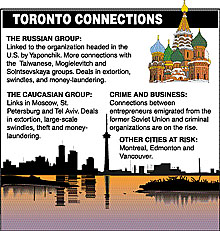
This is an organization that thinks big, and it settled down here in North America." Ben Soave, head of the Combined Forces Special Enforcement Unit, displays little doubt when talking about criminal organizations connected to the former Soviet Union. "It is up-to-date also in regards to the needs imposed by market internationalization." Reality overtook fantasy, went beyond Le Carrè, the Strugatsky brothers, Martin Cruz Smith. "Theres a serious risk," wrote the German paper Bild am Sonntag quoting a report by the German security forces, "that criminal organizations possess very dangerous radioactive materials and that they could try some blackmail against the Western countries or the Arab world." "In Russia," says Arnaud De Borchgrave of the Washington-based Centre for Strategic and International Studies, "there are 100 storage sites for nuclear weapons and materials, but only five of these are adequately protected." Recent operations conducted by U.S. law enforcement agencies uncovered the existence of ongoing talks about the possible sale to some Colombian drug-dealers of a submarine, some helicopters and some surface-to-air missiles. According to Bild am Sonntag, German intelligence and the U.S.s FBI, all seriously worried about the situation, have opened offices in Moscow to collaborate directly with the Russian secret services in their fight against the mob. But, as Fiammetta Cucurnia wrote some years ago on the Italian paper La Repubblica, even if a green light were given to foreign security forces to operate on Russian soil which is pretty unlikely it is difficult to imagine how we could cope with thousands of criminal organizations that have been acting unchecked and in total impunity enriching themselves in these years, becoming very powerful all over Russian territory. Even Boris Yeltsin had to admit that "Russias great disaster is organized crime thats trying and occupying all key posts in economy, gaining ground in politics as well." The words pronounced by Dick Cheney, former U.S. Secretary of Defense, were prophetic; in 1991 he said that in a short time the world would have to deal with the problems generated by the collapse of the former Soviet bloc. It has been calculated that in the last decade hundreds of bosses have left the former Soviet Union and moved to the U.S. and to Canada. Many of them live today in New York City, Atlantic City, Philadelphia, Los Angeles, Baltimore, Chicago, Dallas, Phoenix and Toronto. But the Russian mob has its headquarters in Brighton Beach, Brooklyns Little Odessa. Here, rather than Organizatciya, the mob is known as Malina (literally strawberry, but in the mobs jargon, a meeting point for bosses) and it is particularly violent. Many bosses, the Odesskie Vory (Odessa Thieves), cut their teeth in Soviet jails and boast connections with the mammasantissima of Italian-American Mafia: from the Colombos to the Luccheses, from the Genoveses to the Gambinos. But violence is not exclusive to the Russian mob in New York City. In 1992 in Los Angeles, in order to extort some money from an entrepreneur, a soldier of the Organizatciya threatened to cut out his tongue, rip his eyes out, burn his skin with acid, bankrupt his business and exterminate his family. Finally the entrepreneur paid what had been asked: $475,000. Still in California, in January 1992, a deputy sheriff caught two Russian immigrants while they were cutting to pieces two fellow countrymen guilty of a swindle against a computer company. Violent, but at the same time intelligent. "They are familiar with new technologies, schooling levels above those of other criminal organizations, and they enjoy good connections with high-level political and military circles of the former Soviet Union," explains RCMP Sergeant Reg King, an expert about Easter European mobs. They deal in practically everything: drug peddling, money laundering, extortion, murder, theft. They specialize in fuel smuggling, but most of all in million-dollar swindles against insurance and credit card companies. In Toronto last December the police arrested a group of gangsters who had organized a swindle against major credit card companies in association with members of some Asian gangs. Another characteristic is mobility. FBI discovered that some Brighton Beach bosses were guilty of crimes committed in East Philadelphia, others from Toronto had chosen as their hunting grounds the Atlantic City Casino, and still others from Philadelphia had carried out criminal plans in Los Angeles. 1991 marked one of the first cases in North America involving Boris Goldberg who was charged with being the head of a criminal organization active in New York City and specializing in swindles, cocaine peddling, theft and extortion. Goldberg was also charged with the attempted murder of Evsei Agron, an old boss who had spent many years in Soviet jails and that was held in great esteem in the U.S. in the early Eighties. On January 24, 1984, Goldberg and some of his men tried to kill him, but Agron came off with a few scratches. He was killed in 1995, maybe by his lieutenant, or as some investigators believe, by order of one of the five NYC families of La Cosa Nostra. Canadas situation is not particularly different. Toronto is considered one of the current strongholds of the Russian mob. The strongest group, according to a confidential report by the Canadian intelligence, should be connected to the most powerful organizations, those of Yaponchik, the Taiwanese, and the Mogielevitch. The connections of this group with bosses based in Moscow, St. Petersburg and Tel Aviv (Israel) have also been proved. "The Russian Group," the report states, "deals in extortion, robberies, fencing, swindles against insurance and oil companies, money laundering." Another group operating in Toronto is the "Caucasian" one, which is less influential than the Russian Group, but strongly connected to other organizations in Russia, Austria, Israel and the U.S. And then, as the report underlines, there are close connections between entrepreneurs emigrating from the former Soviet Union and mobsters. This phenomenon can also be spotted in other Canadian cities, such as Montreal, Edmonton and Vancouver. "A landslide of money is entering Canada," says an RCMP investigator. "Many suspicious operations, many companies coming out of nowhere and soon affirming themselves on the financial markets. Buildings appearing like mushrooms after the rain, unstoppable growth. We, with the means at our disposal, can do very little to cope with this new menace against our economy." One of the tricks to enter North America is to claim Jewish roots by using Israel as a springboard. This was the route many vory v Zakone have followed. Russia today is a country adrift. Two thirds of its economy are in the hands of criminal organizations. According to an estimate by the Russian Ministry of Interiors, 40 percent of private companies, 60 percent of public companies and 50-85 percent of banks would be controlled by the mob. But theres also another alarming datum: according to hypothetical estimates, the revenue of criminal organizations could have reached 40 percent of Russias GDP (gross domestic product). Mind-boggling figures that allow bosses to think big, as Soave said. Not only in Russia, but also in the rest of the world. A recent investigation showed that, in order to win a tender, some mobsters did not hesitate to contact and maybe corrupt (this will be ascertained by the current investigation) Boris Yeltsins daughter. There was a public prosecutor who was investigating and appeared keen on exposing the regimes wrongdoings. He was filmed while in the company of two prostitutes, and forced to resign. In Canada, the Russian mobsters have raised the stakes, like the Mafia did at the time of Rocco Perri and Prohibition. Three police officers were indicted for alleged corruption. The Russian mob offered one of them a very precious diamond in exchange for information. And some politicians received contributions for their campaigns, a few thousand dollars that, anyway, alarmed everyone. "Mob-sters coming from the former Soviet Union are used to flirting with power," explains Soave. "They tried to do it here as well, and this threatens the security of our country." (translated by Emanuele Oriano) |
||||||||||||||||||||||||||
|
Part: 1 / 2 / 3 / 4 / 5 / 6 / 7 / 8 / 9 / 10 / 11 / 12 / 13 / 14 / 15 / 16 / 17 / 18 / 19 / 20 / 21 / 22 |
 |