|
Dec 31,2006 - Jan7,2006 |
The tattooed men
Part 17 - The startling power of Japan’s criminal underworld
By Antonio Nicaso
Originally Published: 2001-06-24
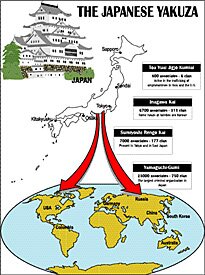
With an army of 60,000 men, active in Japan, the U.S. (California and Hawaii), South America, Europe, the Philippines, South-East Asia and Australia (Queensland), and an annual turnover to the tune of 1,500 billion Yens (about $13 billion US), Yakuza has been dominating the Land of the Rising Sun for centuries, blessed with an impunity that has allowed its growth to go unchecked.
The roots of this group of criminal, financial and political organizations dates back to the 15th century, the time of feudal castes. More or less organized gangs ("machiyakko", servants of the people) were born around 1612 to counter the arrogance of the samurai’s, who were then dispensing death and fear.
They were shrouded in a Robin Hood-like romantic halo, and gained large popular support. The most prominent among them were the Tekiya and the Bakuto. The former derived from the yashi, groups of peddlers that organized in order to protect their own interests from the dictatorship of the Tokugawa family (1542-1612), absolute rulers of Japan. The Tekiya, with the passing of time, became itinerant swindlers. They lied about their products, deceiving villagers. Lastly, they started to extort money from the places they operated in. The role of the Bakuto was different: they limited themselves to controlling gambling, steering clear of local authorities.
The name currently used to designate the Japanese criminal organizations derives from a game that was popular at the time of the Bakuto, the hanafuga (the game of flowers), and in particular to a losing combination of three cards (8-9-3: yakusa). The Bakuto also originated the tradition of the severed finger (as reparation) and of tattoos over the entire body (as a sign of indelible belonging to the ikka or gumi, the criminal family).
In the second half of the 19th century, the Yakuza began to receive increasing government protection, due to its solid connections with the business world. It bands itself along with the ultranationalists and takes part in a terrorist campaign called "government by murder" distinguished by a long series of political killings, including two Prime Ministers and as many Finance Ministers. Tolerated even by the Americans during the occupation after World War II, the Yakuza gained the strength it needed in order to expand. Hand guns replaced swords, and bosses, following the American example, changed their look: sunglasses, dark suits, white shirts, well-matched ties. They also increased in numbers: between 1958 and 1963, by 150 percent.
Page 1/...Page 2
|
| Home / Back to Top |
|
|
 |
|
|



























 </ td>