|
Dec 31,2006 - Jan7,2006 |
Angels* with dirty faces
Part 15 - How the world’s richest and most ferocious motorcycle gang is expanding its wings in Canada
By Antonio Nicaso
Originally Published: 2001-06-24
A newspaper once defined them the richest angels on Earth, but for many they are an organization that manages to make tradition and modernity live side by side, a mix where a ferocious sense of personal loyalty and the willingness to move capitals and people over long distances have been coexisting for decades.
Law enforcement agencies all over the world have recently taken notice of them: "Hell’s Angels lack nothing in comparison to La Cosa Nostra or other organized criminal groups." Maybe they have something more; they are the fastest-growing criminal organization, with 111 "branch offices" spread over three continents: in the U.S., Canada, Austria, Belgium, Denmark, Finland, France, Germany, the United Kingdom, Liechtenstein, Norway, Spain, Sweden, Switzerland, the Netherlands, Australia, New Zealand, South Africa, Brazil and even Italy.
Two former members of Denmark’s Hell’s Angels thus defined those belonging to their organization: "Angels are unrepentant rebels, agents provocateurs by vocation and troublemakers for no specific reason." Their culture is founded on violence, that increases profits in business and is the foundation and guarantee of criminal power in everyday life. In Bikerdome, violence is the seed capital of the outlaw biker: the fundamental element for conquering power and richness and defending them. Without violence there would be no biker gangster: he would be a walking corpse.
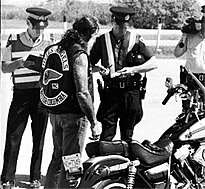
Hell’s Angels, like the other biker gangs, do not hide their affiliation; on the contrary they exhibit it. From this point of view they are very similar to the Japanese gangsters who cover their bodies with tattoos, declaring their belonging to the Yakuza. These are uniformed criminals, even if today, as Canadian crime writer Yves Lavigne wrote, they tend to wear tuxedos more than the leather jackets with the winged skull.
In spite of the changes, they remain unique. "They are an atypical criminal organization," explains RCMP Staff Sergeant Jean-Pierre Levesque, an international expert on motorcycle gangs.
Page 1/...Page 2
|
| Home / Back to Top |
|
|
 |
|
|



























 </ td>