|
Dec.12 - Dec.19, 2004 |
Rome's New Musical Boxes
Italian renowned architect Renzo Piano designs Parco della Musica in ancient Faminio
By Mark Curtis
Originally Published: 2004-10-10
It is doubtlessly an intimidating challenge to improve the architecture of Rome, but leading Italian architect Renzo Piano may have done just that with his design of the city's new Parco della Musica. This new music complex, almost a decade in planning and construction, not only provides Rome with attractive new musical venues, but also acts as a large-scale infill project by returning a previously underused site to the city's urban fabric.
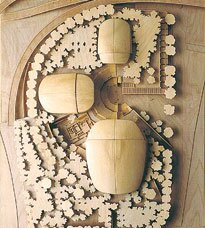
Parco della Musica officially opened last year and the complex boasts three auditoriums as well as a 3,000-seat amphitheatre. Surrounded by hundreds of trees which merge with the neighbouring Villa Glori park of the Flaminio district, Piano calls the buildings "music boxes" which fly above a sea of vegetation. The complex is typical of the bold architectural statement that launched Piano's international reputation. In the 1970s, the Genoa architect teamed with British architect Richard Rogers to design the Centre Pompidou in Paris, a daring new cultural centre featuring mechanical devices such as escalators and ventilation systems prominently showcased on the building's exterior. Such devices are not on show in Rome's new music complex. Instead, Piano's boldness shines through in the three building shapes, which resemble a trio of friendly spaceships which have landed in the historic city.
The largest hall of Parco della Musica contains 2,500 seats and is intended for symphony concerts only. The hall's roof is a sumptuous American cherry wood, ideal for the room's acoustics. A second hall is a 1,200 seater with adjustable staging and seating. The smallest auditorium has seating for 700, but is capable of hosting a variety of events, including opera, chamber music and baroque concerts. As befitting the purpose of the complex, room acoustics were paramount to Piano's design and intended as part of the musical performances. "These halls are large musical instruments, but instead of producing sound, they capture it and return it enriched," Piano says. Lead panels were chosen for the buildings' exterior cladding because of the material's good acoustic insulation properties, but the architect notes that lead has been the traditional choice for Roman domes because it ages well.
Page 1/...Page 2
|
| Home / Back to Top |
|
|
 |
|
|



























 </ td>