|
Feb.20,2005 -Feb.27,2005 |
Enlightened Worship
Architect Richard Meier gives Church a modernist treatment
By Mark Curtis
Originally Published: 2003-11-23
If the archdiocese of Rome was hoping to become a hipper institution - architecturally speaking, anyway - with its 1996 selection of Richard Meier to build a grand new church on the outskirts of Rome, few would have argued with the choice of Meier. He is an American modernist who distills his buildings to their essence.
And so it is essence that shines through the American architect's design of the new Jubilee Church, located in the Rome suburb of Tor Tre Teste and consecrated just last month. Jubilee was originally commissioned for the archdiocese's Millennium Project, but the church is now also known as Dio Padre Misericordioso in celebration of the 25th year of the pontificate of Pope John Paul II. It is the 50th new church and community centre built in recent years in the Rome area by the archdiocese and 15 more are planned.
"When I think of a place of worship, I think of a place where one can sit and be reminded of all the things that are important outside our individual lives," Meier said last month. The veteran New York architect said "to express spirituality, the architect has to think of the original material of architecture, space and light". Along with form, the three elements have provided the foundation for Meier's award-winning 40-year practice.
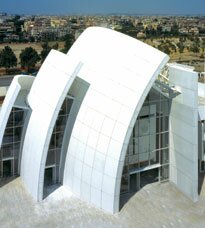
The exterior of Dio Padre Misericordioso is remarkable for its three white concrete shells, resembling ship sails, the tallest of which reaches 88 feet in height. Glazed skylights connect the shells which, along with a spine wall, constitute the church nave. The white concrete forms are intended to suggest the Holy Trinity and a reflecting pool recalls baptismal waters. Meier says the trio of shells "define an enveloping atmosphere in which the light from the skylights above create a luminous spatial experience, and the rays of sunlight serve as a mystic metaphor of the presence of God". The white concrete used for the project was first invented for Pier Luigi Nervi's design of Rome's Olympic Stadium for the 1960 Games. "The engineering effort involved in erecting the shells was Herculean and Italcementi (a project construction partner) did a fantastic job of realizing my design," says Meier, who received the prestigious Pritzker Prize for architecture in 1984. In accepting the award, Meier noted the benefit of choosing white as a building colour. The architect said "the whiteness of white is never just white; it is almost always transformed by light and that which is changing; the sky, the clouds, the sun and moon".
Page 1/...Page 2
|
| Home / Back to Top |
|
|
 |
|
|



























 </ td>