|
Jan.2, 2005 - Jan.9, 2005 |
The Sublime and the Terrible
Once Upon A Time There Was Naples exhibition in Rome's Palazzo Caffarelli
By Carmela Piccione
Originally Published: 2003-11-16
The gouaches, despite being highly sought after by antiquarians, have been largely ignored by art historians, who saw them more as craft than art. The historians' opinion remained unchanged until a few dedicated collectors, in the Sixties, managed to get the gouaches out of oblivion. This, in a nutshell, is the story of the gouaches. Now they are the subject of an exhibition entitled C'era una volta Napoli (Once Upon a Time There Was Naples), running until November 16 in the halls of Palazzo Caffarelli in Rome. "This confirms our city's longstanding commitment," explained Rome Mayor Walter Veltroni, "to using cultural events for promoting collaborations with other cities, regions and countries."
Following a thorough critical reassessment, gouaches have been recognized as a form of art holding considerable documentary worth. In the words of Gianni Borgna, Councillor in charge of Rome's cultural policies, "the gouaches illustrate Naples as it was in the 18th and 19th centuries; it's a city that no longer exists except in our collective memories."
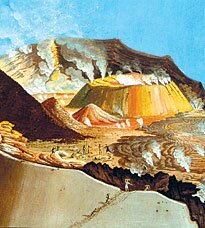
This exhibition splits in three the emotions of a traveller of that age. The first section, Classical, contains the views of classical ruins and panoramas that travellers brought back with them as tangible souvenirs; the second section, Sublime, shows the spectacular eruptions of Mt. Vesuvius; the third one, Picturesque, tackles the complex relation between art and nature with folkloric scenes and views of the city.
The artists of the 1700s felt a strong attraction towards Naples and Campania, where they could find some of the cultural and spiritual issues of the time within the context of everyday reality. The archaeological sites at Herculaneum, Pompeii, and the Phlaegrean Fields, the mild climate, the bright light of the sun, and even the terrifying charm of the volcano all exerted a powerful pull. These factors induced gouache painters to depict the city and its gulf, rich in evocative power.
In the late 17th and early 18th century, a fundamental role was played by the work of Gaspar van Wittel, who revolutionized the idea of landscape by using a camera obscura, thus beating a path that was to be followed by numerous artists from every region of Italy and country of Europe, e.g. Tommaso and Juan Ruiz, Gabriele Ricciarelli, Saverio Della Gatta, and Thomas Jones. Also fundamental was the long stay in Naples of Philipp Hackert, who asserted the principle of documentary fidelity.
Page 1/...Page 2
|
| Home / Back to Top |
|
|
 |
|
|



























 </ td>