|
Sept 7 - Sept 14,2003 |
In The Image Of The World
Italian design veteran Ettore Sottsass continues to influence aficionados
By Mark Curtis
Those who believe that many designers take themselves too seriously would probably get little argument from Ettore Sottsass. The Italian design legend has been flouting the rules for much of his storied career. Typical of Sottsass' often contrarian approach, he once said, "I don't understand why enduring design is better than disappearing design."
Sottsass has challenged design conventions since the 1960s, when his work and university lectures became increasingly sympathetic to the Radical Design movement in Italy, which included groups such as Archizoom and Superstudio. His own challenges to the strict functionalism of modern design became apparent in his work with the group Alchimia and later - and more spectacularly - with the Memphis group.
His career has had a strange trajectory considering that his father was one of Italy's leading Rationalist architects of the 1920s and 30s. (The Rationalists in Italy took up the cause of modernism happening elsewhere in Europe.) Sottsass the younger's professional career began conventionally enough. He earned his architecture degree from Turin Politecnico in 1939 and after serving in the Second World War he opened his first studio in Milan in 1947. He helped business machine giant Olivetti solidify its position as a design-friendly enterprise through designs such as the Elea 9003, Italy's first mainframe computer, as well as the iconic Valentine typewriter. In a review of an Olivetti retrospective held last spring at the Centre Georges Pompidou in Paris, historian Simon Texier wrote that "...in the light of computer history, the machines conceived by Sottsass are already prehistoric, which makes them all the more moving. Each nevertheless bears witness to the rigour of the designer's approach, based more on sense than form."
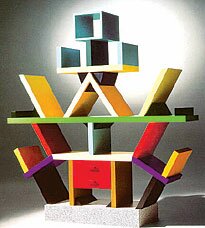
It is this sense of sense that Sottsass has chased since the 1960s. By the time he co-founded the Memphis movement in 1981 (along with other design luminaries such as Michele de Lucchi and Andrea Branzi), Sottsass was ready to tear apart the conceits of modernism and replace them with designs which were intended to interact and delight the user, rather than stand quietly in the corner and be spoken of in hushed tones. The designs of Memphis were loud and proud, recalling mid-century kitsch with a knowing wink. They profoundly influenced design for the entire decade and in retrospect the Memphis sensibility now seems inseparable from the entire Yuppie zeitgeist. Although splashy, Sottsass' underlying goal was to involve the user and extend a metaphoric hand to his audience, rather than expect them to warm to the dry design vocabulary of modernism. His Carlton room divider/bookshelf became a signature Memphis design.
Page 1/...Page 2
|
| Home / Back to Top |
|
|
 |
|
|




























 </ td>