|
Dec.26/04 - Jan.2, 2005 |
18 - Long Live the Language of Love
Professor Konrad Eisenbichler dissects language in time of multiculturalism
By Antonio Maglio
Originally Published: 2003-04-27
 |
|
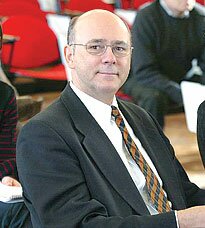
Professor Konrad Eisenbichler
|
How can one talk about survival of the Italian language in Canada when there is a war, waged by so few, that denies survival to so many innocent people? This is the question posed to Konrad Eisenbichler, professor of Italian Renaissance, and Associate Chair and Graduate Co-ordinator of the Department of Italian Studies at the University of Toronto.
"Don't ask me. I am one of the many victims of the Second World War," says Eisenbichler. "I don't only remember the innocent people losing their lives because of this conflict, or the shattered balance. I also remember the refugees, forced to leave their homes and their land and to roam the world looking for another home, another land. This strikes a chord in my heart, as the same thing happened to us Istrians at the end of World War II, as an effect of the division of Europe: we had to leave everything and go, right away. We lost everything, even our identity. My family got divided, took different ways and citizenships, and lived in separation. We lost contact with one another and were never able to reassemble the shreds of our history."
Technically he's an Austrian-Canadian, Eisenbichler hasn't lost hope of one day obtaining the Italian citizenship "that only historic events took away from me at birth."
In 2000, one of his numerous publications, The Boys of The Archangel Raphael: a Youth Confraternity in Florence, 1411-1785, received the prestigious "Howard R. Marraro" Award, presented annually by the American Catholic Historical Association to the best book on the history of Catholicism. The book is the fruit of a 10-year research that Eisenbichler conducted in Florence on the religious and secular phenomenon of the confraternities; as to the one specifically under exam, the Confraternity of the Archangel Raphael, he illustrated its 375 years of life with a wealth of documents. But even beyond the research, this book is testimony to the solidity of the bond between its author and the culture of Italy. That bond was the theme of two crowded conferences held by Eisenbichler in February at the University of Trieste, where he spoke on the role of the Julian-Dalmatian people within Italian emigration to Canada and of literature and society in Italian Renaissance.
Page 1/...Page 2
|
| Home / Back to Top |
|
|
 |
|
|



























 </ td>