|
Oct. 31 - Nov. 7, 2004 |
10 - World-wide strategy for Italian
The importance of keeping language and dialects alive in Italy as well
By Antonio Maglio
Originally Published: 2003-03-16
 |
|
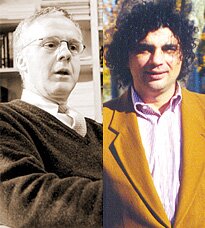
Luca Codignola and Donato Santeramo
|
Umberto Galimberti, philosopher of history, sounded the alarm on the cultural pages of La Repubblica. He did so last January 15. Dissecting the reform of Italian education proposed by Minister Letizia Moratti, he expressed many perplexities on the three "I's" that should mark this reform: Impresa (business), Informatica (IT) and Inglese (English).
Business and IT do not fall within the scope of this report. Massive study of the English language, on the other hand, does, insofar as it will be imposed on a student population lagging behind in the knowledge of its maternal tongue, Italian. Galimberti made an example: "In 1975, a schoolchild knew 1,500 words; nowadays just 650." He added: "When words fail them, they use profanities to express what is otherwise inexpressible, for lack of vocabulary. They resort to a language that is poor and inarticulate and that carelessly mixes subjunctives and conditionals, interspersed with infinite 'you know', 'I mean', 'that is' and other similar expressions used while searching for words that cannot be found, since they were never learnt in the first place." His conclusion: "Wouldn't it be better if, before English, these kids were taught Italian?"
Galimberti has nothing against the English language. On the contrary, he maintains that "as it has become, due to the U.S. hegemony, the world language, our students would do well to learn it, so they can move nimbly in this age of globalization." But education must work by priorities, clarified Galimberti, and studying Italian is among them.
A strange destiny: while in Italy the Italian language encounters contamination and troubles, abroad it is increasingly becoming a "language in use" not just as the language of high culture but also as an asset in the workplace. The same destiny of Italy, whose image abroad shines brighter than at home.
Will English be the only language of globalization? This is not the opinion of Luca Codignola. "I think that in the future everyone will use, like many already do, two languages, if not three: English, the national language, and possibly a local language as well. There are several levels of communication, and these three realities can easily coexist; people will talk in English in order to chat with others abroad, in Italian to talk with Italians, and in Friulian or Sicilian to communicate locally. This is what is happening today. Of course, for some people this multilingualism will entail an impoverishment of the lexicon, meaning that they will know fewer words although in several languages; others will be enriched, as the various languages are doors open onto different yet parallel cultures."
Page 1/...Page 2
|
| Home / Back to Top |
|
|
 |
|
|



























 </ td>