|
Dec.26/04 - Jan.2, 2005 |
2 - Growing Power of the Italian language
The increase demand for the study of the bella lingua reflects on culture around the world
By Antonio Maglio
Originally Published: 2002-12-08
 |
|
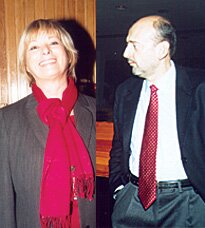
Chiara Abatecola and Massimo Vedovelli
|
The starting point is some research conducted by Tullio De Mauro among the Istituti Italiani di Cultura around the world. It revealed that the diffusion of the Italian language is constantly expanding, and the language ranks among the top five most studied abroad. The report also delved into the reasons for attending the courses (students increased by 38.2 percent in the last five years): not just because it is the language of art, music, great literature, but also because of its good "social usefulness", meaning that it entails good job opportunities. Other reasons are linked to tourism, new industrial products (fashion, cars, furniture), lifestyle, gastronomy, or an Italian or Italian-heritage partner.
But even among the reasons for this success, two elements stand out. Italian is studied abroad because it is the language of a trendy country and of a community that has won respect and authority wherever it settled.
Among many positive elements, De Mauro did not hesitate to underscore a negative one. "In comparison to the remarkable increase in the number of students and courses," he wrote in his closing report, "teachers increase less: only 8.4 percent more than in 1995."
"This is one of the dark spots in the success of the Italian language abroad," says Massimo Vedovelli, Pro-rector of Siena's University for Foreigners and leader of the research team that worked with De Mauro. "In fact, teachers are few and they cannot meet the demand. The solution requires additional financial resources, additional investments. But the problem is more complex than that, because the potential for expansion of the Italian language abroad is subject to many variables."
Could you list some of them?
"The scarcity of teachers is one of the major ones. Another one is the attitude of the directors of the Istituti Italiani di Cultura, where De Mauro's research was carried out. Well, not all of them managed to do what Carlo Coen did in Toronto, quadrupling the number of students enrolled in Italian courses. Other directors do not deem the study of the language to be a priority in their cultural policy. Language courses are held where there are many potential students: Canada, for instance, Japan, Mexico; but Africa is an island of absence from this standpoint. Cultural promotion is not homogeneous all over the world."
Page 1/...Page 2
|
| Home / Back to Top |
|
|
 |
|
|



























 </ td>