|
|
|
 |
July 17 - August 21, 2011 |
4 - How Italians taught Britons to laugh
Prof. Lucio Sponza examines the wave of immigration to the United Kingdom
By Antonio Maglio
Originally Published: 2002-08-04
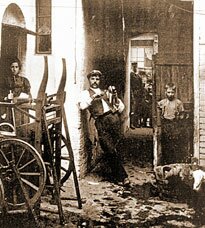
They defied the metallic cold of these regions as far back as the early decades of the 19th century, arriving where the sea has the colour of steel and in winter the waves freeze on the rocks, creating ice sculptures. Lombards, Emilians and Tuscans were the first to set foot on the white cliffs of Dover. Some of them settled in southern England; other pushed north to Hadrian's Wall and beyond. Yet more continued beyond Craster, in the vicinity of Edinburgh, an outpost in the Scottish Highlands where fishermen smoke herrings and whiskey has the flavour of peat. They did not simply trade; they imported a mindset, made of fantasy and realism.
"Those from Como," says Lucio Sponza, professor at Westminster University and author of several books on Italian immigration to Britain, "sold barometers and thermometers that they themselves built; they required just a few drops of mercury in a glass pipe. People from Piacenza and Parma began as pedlars and storytellers, then took up the most diverse jobs, and finally, relying on their solid gastronomic tradition, they opened the first Italian-style public houses. Those from Lucca made and sold gypsum statuettes, which were a success among the British. That was essentially an immigration from northern Italy, and this state of things went on until World War II."
In the late Fifties, Rome and London reached an agreement to fill the ranks of the British industries brought to their knees by the war. The point was to rebuild the factories destroyed in the bombings, and to resume operations. There was an urgency, as those factories had been a pillar of British economy since the 18th century. So, peasants from southern Italy boarded the trains to Calais, and after landing in Dover those to Swansea, Bedford, and Peterborough, bound for steel mills and brick factories. Many spent their entire working life there; other people, after mastering the language, took up trading, importing foodstuff from Italy or even producing them "the Italian way". For instance, pastries and ice cream, which won the hearts - and the taste buds - of the British.
Page 1/...Page 2
|
Comments
CorriereTandem.com editors reserve the right to edit, review and allow or reject, in their entirety, website comments. Those comments that are posted are not the opinions of Corriere Canadese/Tandem, or Multimedia Nova Corporation nor its affiliates but only of the writer. Spelling and grammar errors will not be corrected. We will not allow comments that include personal attacks on citizens at large; comments that make false or unsubstantiated allegations; comments that claim to quote people or reports where the quote or fact is not publicly known; or comments that include vulgar language or libelous statements.
|
| Home / Back to Top |
|
|
 |
|
|
|




























 Share
Share